
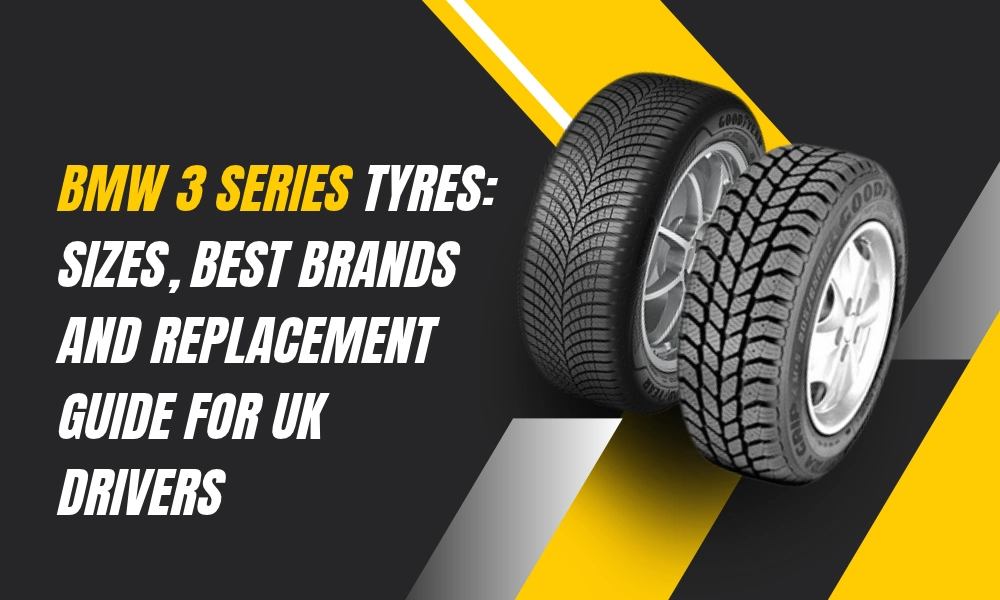
BMW 3 Series Tyres: Sizes, Best Brands and Replacement Guide for UK Drivers
Choosing replacement tyres for a BMW 3 Series requires more than finding the right wheel diameter. Depending on the model, your BMW may use run-flat tyres, different front and rear tyre sizes, or tyres with BMW-specific manufacturer approval.
Whether you drive a BMW 320d, 320i, 330e or M340i, the correct tyres can affect handling, braking, ride comfort and everyday driving costs.
This guide explains common BMW 3 Series tyre sizes, the difference between run-flat and standard tyres, which brands to compare, and how to find suitable replacement tyres online.
What Tyre Size Does a BMW 3 Series Need?
BMW 3 Series tyre sizes vary by model year, engine, trim and wheel package.
A BMW 320d with standard 17-inch wheels may use different tyres from an M Sport version fitted with 18-inch or 19-inch alloys.
Some BMW 3 Series models also use staggered tyre sizes, meaning the rear tyres are wider than the front tyres.
Common BMW 3 Series Tyre Sizes
|
Tyre size |
Typical applications |
|
Selected older F30-generation models |
|
|
Selected F30 and G20 specifications |
|
|
Selected 18-inch configurations, including front tyres on staggered setups |
|
|
Rear tyres on selected 18-inch staggered setups |
|
|
Front tyres on selected 19-inch staggered setups |
|
|
Rear tyres on selected 19-inch staggered setups |
These are common examples, not a complete list of approved fitments.
The correct tyre specification also includes the load index, speed rating and any requirements relating to run-flat construction or manufacturer approval.
Before ordering tyres, check the markings on your existing tyres, the vehicle's tyre information label and the manufacturer's specifications.
You can also search for replacement tyres using your vehicle registration at TyreSavings.com.
Do BMW 3 Series Cars Have Different Front and Rear Tyre Sizes?
Yes, some BMW 3 Series models use wider rear tyres than front tyres.
This is known as a staggered tyre setup.
For example, selected BMW 3 Series models with 18-inch wheels use:
|
Position |
Tyre size |
|
Front |
225/45 R18 |
|
Rear |
255/40 R18 |
Selected 19-inch configurations may use:
|
Position |
Tyre size |
|
Front |
225/40 R19 |
|
Rear |
255/35 R19 |
These combinations must not be assumed suitable for every BMW 3 Series.
Why Does BMW Use Wider Rear Tyres?
On certain performance-oriented configurations, staggered tyres form part of the vehicle's intended handling and traction characteristics.
However, staggered setups also have practical implications.
- Front and rear tyre sizes must be ordered separately.
- Front-to-rear tyre rotation is generally not possible.
- Replacement prices may differ between axles.
- The approved wheel and tyre combination must be maintained.
Before buying a full set of four tyres, check whether your BMW uses the same size on every wheel.
Shop common BMW tyre sizes:
Does a BMW 3 Series Need Run-Flat Tyres?
Many BMW 3 Series vehicles come with run-flat tyres, although not every model or specification uses them.
Run-flat tyres are designed to allow limited continued driving after certain types of pressure loss, within the tyre manufacturer's restrictions.
They can provide additional mobility following a puncture, but they are not puncture-proof.
How to Identify BMW Run-Flat Tyres
BMW commonly uses the term RSC, meaning Runflat System Component.
You may also encounter manufacturer-specific markings such as:
- RFT: Run Flat Tyre
- SSR: Self-Supporting Runflat
- ROF: Run On Flat
- EMT: Extended Mobility Technology
Check the tyre sidewall and vehicle documentation to confirm the required construction.
BMW Run-Flat vs Standard Tyres
|
Feature |
Run-flat tyres |
Standard tyres |
|
Driving after pressure loss |
Limited continued mobility under specified conditions |
Normally requires stopping safely |
|
Purchase cost |
Often higher |
Usually more price choices |
|
Ride comfort |
Can feel firmer depending on model |
May provide a more compliant ride |
|
Availability |
More limited in certain sizes |
Often wider selection |
|
Puncture arrangements |
Designed for limited mobility after qualifying pressure loss |
Requires appropriate repair or recovery arrangements |
Some BMW drivers consider switching to standard tyres to change ride comfort or reduce replacement costs.
However, this must be assessed against the vehicle manufacturer's requirements, tyre pressure monitoring system, wheel compatibility and puncture recovery arrangements.
Do not mix run-flat and standard tyres without confirming that the configuration is permitted.
Read our run-flat vs standard tyres guide for more information.
What Does the BMW Star Marking on Tyres Mean?
Some tyres designed and approved for BMW vehicles carry a star marking on the sidewall.
This marking identifies tyres developed or approved to BMW's specifications.
BMW star-marked tyres can differ from standard versions of a similar tyre model in characteristics such as construction, tuning or performance requirements.
When buying replacement tyres, check whether your particular BMW requires or recommends BMW-approved tyres.
This is especially important on vehicles where matching tyre characteristics across axles affects the drivetrain.
For xDrive models, differences in tyre circumference and wear can also matter. Follow BMW's specifications for permitted combinations and replacement.
A tyre carrying a BMW star marking is not automatically suitable for every BMW model. The exact tyre dimensions and specifications must still match your vehicle.
Which Tyre Brands Are Best for a BMW 3 Series?
No single brand suits every BMW 3 Series driver.
The right choice depends on the model, wheel size, driving style and budget.
Here are five brands worth comparing when looking for replacement BMW 3 Series tyres.
1. Michelin Tyres: Premium Touring and Performance Options
Michelin offers tyres across touring, performance and all-season categories.
For BMW 3 Series drivers, the Primacy family may suit everyday touring, while compatible Pilot Sport models are worth comparing for performance-oriented applications.
Potential advantages include a choice of products designed around different driving priorities.
However, not every Michelin tyre is available in BMW-approved or run-flat construction.
Check the exact tyre model and specification before purchasing.
2. Continental Tyres: Everyday Comfort and Handling
Continental offers several passenger-car tyre ranges that may suit different BMW 3 Series configurations.
The PremiumContact family is aimed at touring applications, while SportContact products focus more on performance-oriented driving.
These are worth comparing if wet braking, steering response and handling are important to you.
Check independent tyre tests for the exact product rather than relying solely on manufacturer descriptions.
Comparing the two? Read our Continental vs Michelin tyres guide.
3. Bridgestone Tyres: Run-Flat and Performance Choices
Bridgestone has supplied tyres for a variety of BMW applications.
Its range includes conventional and run-flat products in selected dimensions.
Depending on the required tyre specification, Bridgestone's Turanza and Potenza families may be relevant.
Turanza products generally focus on touring applications, while Potenza tyres are aimed at more performance-oriented use.
Availability of BMW-approved or run-flat versions varies by product.
4. Goodyear Tyres: Touring and Performance Alternatives
Goodyear offers touring and performance tyres suitable for a variety of passenger cars.
For everyday BMW 3 Series use, certain EfficientGrip products may be worth comparing.
For drivers looking at performance-focused tyres, the Eagle F1 family provides additional options.
Goodyear also offers run-flat technology in selected products.
Compare the correct tyre size, construction, speed rating and load index before ordering.
5. Hankook Tyres: Mid-Range and Premium Alternatives
Hankook is worth comparing if you're looking for options beyond the most established premium tyre brands.
The Hankook Ventus family includes tyres aimed at touring and performance applications.
Some Hankook products are also available with BMW-specific original-equipment approvals.
As with other brands, the model name alone does not establish vehicle compatibility.
Always check the complete specification.
Best Tyres for a BMW 320d or 320i
BMW 320d and 320i models are often used for commuting, motorway journeys and general everyday driving.
For these vehicles, the right tyre depends on whether you prioritise comfort, handling, wet-weather performance or long-term value.
A touring-focused tyre is often a sensible category to compare.
Consider:
- Wet grip: Important for braking on UK roads in rainy conditions.
- Road noise: Particularly relevant if you regularly drive long motorway distances.
- Rolling resistance: May influence fuel consumption, although real-world results depend on several factors.
- Ride comfort: Low-profile tyres and run-flat construction can affect how bumps and uneven surfaces feel.
- Replacement cost: A premium tyre may cost more initially, but purchase price alone does not indicate overall value.
Suitable Michelin Primacy, Continental PremiumContact, Goodyear EfficientGrip and Hankook Ventus products are examples worth investigating, subject to the correct specification.
Best Tyres for a BMW 330e Plug-In Hybrid
The BMW 330e is a plug-in hybrid that combines a petrol engine with an electric motor and traction battery. Our guide to the best tyres for hybrid cars explains what to look for.
The vehicle's weight and performance characteristics make it important to choose tyres that meet the manufacturer's load and speed requirements.
For a BMW 330e, consider:
- The correct tyre size and load rating
- BMW approval requirements
- Wet braking performance
- Rolling resistance
- Road noise
- Run-flat compatibility where applicable
You don't automatically need tyres marketed specifically for electric vehicles.
A compatible passenger-car tyre that meets BMW's requirements may be appropriate.
However, never choose a tyre with an insufficient load rating simply because it is cheaper or has a favourable efficiency label.
Best Tyres for a BMW 3 Series M Sport
BMW M Sport models often feature larger alloy wheels and may use lower-profile tyres or staggered wheel configurations.
These characteristics can influence handling, ride comfort and replacement costs.
If you drive a BMW 3 Series M Sport, consider:
- Whether your vehicle uses different front and rear tyre sizes
- Whether it has run-flat tyres
- The required load and speed ratings
- BMW star-marked tyre recommendations
- Your preference for comfort versus performance
Premium performance tyre families such as Michelin Pilot Sport, Continental SportContact, Bridgestone Potenza and Goodyear Eagle F1 may be worth comparing where compatible.
A tyre designed for performance driving isn't necessarily the best choice for someone who mainly uses their M Sport for everyday commuting.
How Much Do BMW 3 Series Tyres Cost in the UK?
BMW 3 Series tyre prices vary significantly by wheel size, tyre brand and construction.
An older 3 Series fitted with 16-inch wheels may have a different selection of replacement products from a newer M Sport model with staggered 19-inch tyres.
The following factors influence pricing:
|
Factor |
Why it matters |
|
Tyre size |
Larger and less common sizes can cost more |
|
Run-flat construction |
Often commands a higher purchase price |
|
BMW star marking |
Approved versions may differ in availability and price |
|
Brand |
Budget, mid-range and premium choices vary in cost |
|
Staggered setup |
Front and rear tyres may have different prices |
|
Fitting |
Check whether fitting and associated services are included |
Instead of assuming a fixed BMW 3 Series tyre price, compare current products for your exact vehicle specification.
For example, if your BMW uses 225/45 R18 front tyres and 255/40 R18 rear tyres, check prices and specifications for both dimensions.
Compare BMW 3 Series tyre prices at Tyre Savings
Are Budget Tyres Suitable for a BMW 3 Series?
Budget tyres can offer a lower initial replacement cost, but price should never be the only deciding factor.
BMW 3 Series vehicles vary from everyday saloons to more powerful performance-oriented models.
Before buying lower-priced tyres, compare:
- Correct tyre dimensions and load ratings
- Wet-grip performance
- Manufacturer requirements
- Independent tyre test results
- Run-flat or standard construction
- Suitability for the intended driving conditions
For a higher-performance BMW or a model with specific drivetrain requirements, an inappropriate tyre choice can create problems regardless of the price.
A compatible mid-range tyre may represent a reasonable compromise between cost and features.
Should You Buy Summer or All-Season Tyres for a BMW 3 Series?
Most drivers choosing replacement tyres will encounter summer and all-season options.
Summer Tyres
Summer tyres are designed for warmer, generally milder driving conditions.
They are widely available across touring and performance categories.
For drivers prioritising handling in typical warm-weather conditions, a suitable summer tyre may be appropriate.
All-Season Tyres
All-season tyres are designed to provide a compromise across a broader range of temperatures and weather conditions.
They may appeal to drivers who experience colder winters or occasional light snow but do not want separate summer and winter tyre sets.
However, they cannot match every characteristic of specialised summer and winter tyres.
Before buying, check that the all-season tyre is available in your BMW's required size and load rating, and that the proposed setup meets the vehicle manufacturer's requirements.
Explore all-season tyres at Tyre Savings.
When Should BMW 3 Series Tyres Be Replaced?
Tyres should be inspected regularly for wear, damage and deterioration.
For passenger cars in Great Britain, the legal minimum tread depth is 1.6 mm across the central three-quarters of the tread around its entire circumference.
However, some tyres require replacement before reaching that limit.
Look for:
- Bulges, cuts or exposed cords
- Uneven tread wear
- Persistent pressure loss
- Damage caused by potholes
- Age-related deterioration
- Unusual vibration or handling changes
If your BMW uses staggered tyres, pay particular attention to differences in wear between the front and rear axles.
For xDrive vehicles, follow BMW's guidance on tyre matching and permitted wear differences.
If you're uncertain whether a tyre is safe, arrange a professional inspection. Not sure if it needs repair or replacement? Our guide can help.
How to Buy BMW 3 Series Tyres Online
Tyre Savings allows UK drivers to compare tyre brands, sizes and prices online.
Step 1: Search for Your Vehicle
Enter your BMW registration number or search using your tyre size.
Step 2: Check Front and Rear Tyre Requirements
Confirm whether your vehicle uses the same tyres on every wheel or has a staggered setup.
Step 3: Compare Compatible Tyres
Check brand, price, load and speed ratings, run-flat construction and relevant manufacturer approvals.
Step 4: Choose a Local Fitting Option
Select a participating fitting garage and review available appointments and the total fitted price.
Step 5: Complete Your Order
Confirm that the tyres selected match your BMW's specifications before completing your booking.
Find BMW 3 Series tyres at TyreSavings.com
Find the Right BMW 3 Series Tyres at Tyre Savings
Whether you drive a BMW 320d, 320i, 330e or M Sport model, choosing replacement tyres starts with confirming the correct specifications.
Check whether your vehicle uses run-flat tyres, whether the front and rear sizes differ, and whether BMW-approved tyres are recommended.
Once you know the correct requirements, you can compare budget, mid-range and premium tyre brands to find a suitable balance of performance, comfort and price.
Shop BMW 3 Series tyres online at Tyre Savings
Frequently Asked Questions
What tyre size does a BMW 320d use?
BMW 320d tyre sizes vary by model year, generation and wheel package. Examples include 205/60 R16, 225/50 R17 and selected 18-inch or 19-inch configurations. Check the exact vehicle specifications before buying.
Do BMW 3 Series cars need run-flat tyres?
Not every BMW 3 Series requires run-flat tyres. Requirements vary according to the vehicle's original equipment and approved tyre configurations.
Can I replace BMW run-flat tyres with normal tyres?
A change may be possible on certain configurations, but it should only be considered after checking BMW's requirements, wheel compatibility, pressure monitoring and puncture recovery arrangements. See run-flat vs standard tyres for the full comparison.
Why does my BMW have wider rear tyres?
Some BMW 3 Series models use staggered tyre configurations as part of their intended traction and handling characteristics. Front and rear tyres must match the approved vehicle specifications.
What does the star on a BMW tyre mean?
The star marking identifies a tyre developed or approved according to BMW's specifications. It doesn't mean that the tyre is suitable for every BMW model.
What are the best tyre brands for a BMW 3 Series?
Michelin, Continental, Bridgestone, Goodyear and Hankook all offer tyres worth comparing. The best option depends on the exact tyre specification, driving conditions and budget. Browse all tyre brands available at Tyre Savings.
Can I use all-season tyres on a BMW 3 Series?
All-season tyres may be suitable where an appropriate approved or compatible specification is available. Check vehicle requirements, including any staggered or xDrive-specific considerations, before changing tyre type.